

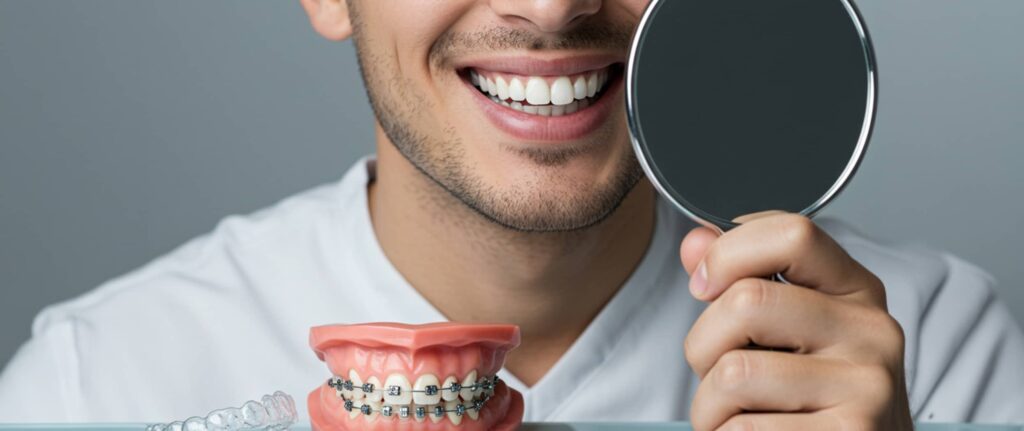
So you’ve decided you want straighter teeth — brilliant decision. But now comes the next question: Invisalign or traditional braces? It’s one of the most common questions we hear at Hey Dental, and the honest answer is that neither option is universally better. The right choice depends entirely on your teeth, your lifestyle, and what you’re trying to achieve.
Let’s break it all down so you can walk into your consultation feeling confident and informed.
How Invisalign works
Invisalign uses a series of clear, removable plastic trays (called aligners) that are custom-made to gradually shift your teeth into the desired position. You swap to a new set of aligners every one to two weeks, each set making tiny adjustments. The aligners are virtually invisible — most people won’t even notice you’re wearing them — and you take them out to eat, drink, and brush your teeth.
Treatment time varies depending on complexity, but many cases are completed within six to eighteen months. For mild to moderate crowding, spacing issues, or bite problems, Invisalign is extremely effective. At Hey Dental we use advanced digital scanning to map out your entire treatment journey before you start, so you can actually see a simulation of your final result.
How traditional braces work
Traditional braces use metal brackets bonded to your teeth, connected by a wire that your orthodontist adjusts periodically. They apply continuous, controlled pressure to move teeth into alignment. Modern braces are far smaller and more comfortable than the chunky metal brackets of decades past, and there are even ceramic (tooth-coloured) options for a more discreet look.
Braces are incredibly versatile. They can handle severe crowding, complex bite issues, and rotations that clear aligners sometimes struggle with. Treatment typically takes twelve to twenty-four months, though this varies widely. One of the advantages of braces is that they work around the clock without requiring any discipline from the patient — they’re always on, always working.
The lifestyle factor
This is often the deciding point for adults. Invisalign aligners are removable, which means no food restrictions — you can eat whatever you like. You simply pop them out, enjoy your meal, brush your teeth, and put them back in. Braces, by contrast, come with a list of foods to avoid (sticky sweets, popcorn, hard nuts) because they can damage brackets and wires.
The catch with Invisalign? Discipline. You need to wear your aligners for twenty to twenty-two hours a day for them to work properly. If you’re someone who might forget to put them back in after lunch, or if you’re prone to losing things, that’s worth thinking about honestly.
For teenagers, both options work well. Many teens love the idea of invisible aligners, but braces can actually be a better fit for younger patients who might not be diligent enough about wear time. At Hey Dental, we always have a frank conversation with teen patients (and their parents) about which option suits their personality and daily routine.
What can each option treat?
Invisalign has come a long way. It can now treat a wide range of orthodontic issues including crowding, spacing, overbites, underbites, crossbites, and open bites. However, there are still cases — particularly severe skeletal discrepancies or complex tooth movements — where traditional braces have the edge.
If your case is on the milder side, Invisalign is likely a great fit. For more complex situations, braces might get you to your goal more predictably. And in some cases, a combination approach works best — starting with braces for the heavy lifting, then refining with aligners.
Cost comparison
In Dubai, the cost of Invisalign and braces is often comparable, though it varies based on the complexity of your case and the length of treatment. Invisalign can sometimes be slightly more expensive for complex cases, while straightforward braces cases might come in a bit lower. Many clinics, including Hey Dental, offer flexible payment plans to make either option more accessible.
The real value isn’t just in the sticker price — it’s in the expertise of the person planning your treatment. A well-planned case with an experienced clinician will always deliver better results than a bargain deal with someone less qualified.
What about the pain?
Let’s be real — both options involve some discomfort. You’re moving teeth, after all. With Invisalign, you’ll typically feel pressure and mild soreness for a day or two each time you switch to a new set of aligners. With braces, adjustments can cause similar soreness, and brackets can occasionally irritate the inside of your cheeks (though dental wax helps enormously).
Neither option is agonising. Most patients describe it as pressure rather than pain, and it’s very manageable with over-the-counter painkillers if needed.
The bottom line
There’s no single right answer for everyone. The best orthodontic treatment is the one that’s been carefully planned for your specific teeth, your bite, and your life. At Hey Dental, we take the time to assess all of these factors before recommending a path forward. Whether that’s Invisalign, braces, or a combination, the goal is always the same: a healthy, beautifully aligned smile that you’re proud of.
If you’ve been putting off straightening your teeth because you weren’t sure which option to choose, consider this your nudge. Book a consultation, ask all the questions, and take that first step. A straighter smile isn’t just about aesthetics — properly aligned teeth are easier to clean, reduce your risk of decay and gum disease, and can even alleviate jaw pain caused by a misaligned bite. Whatever route you choose, the investment pays dividends for decades to come.